
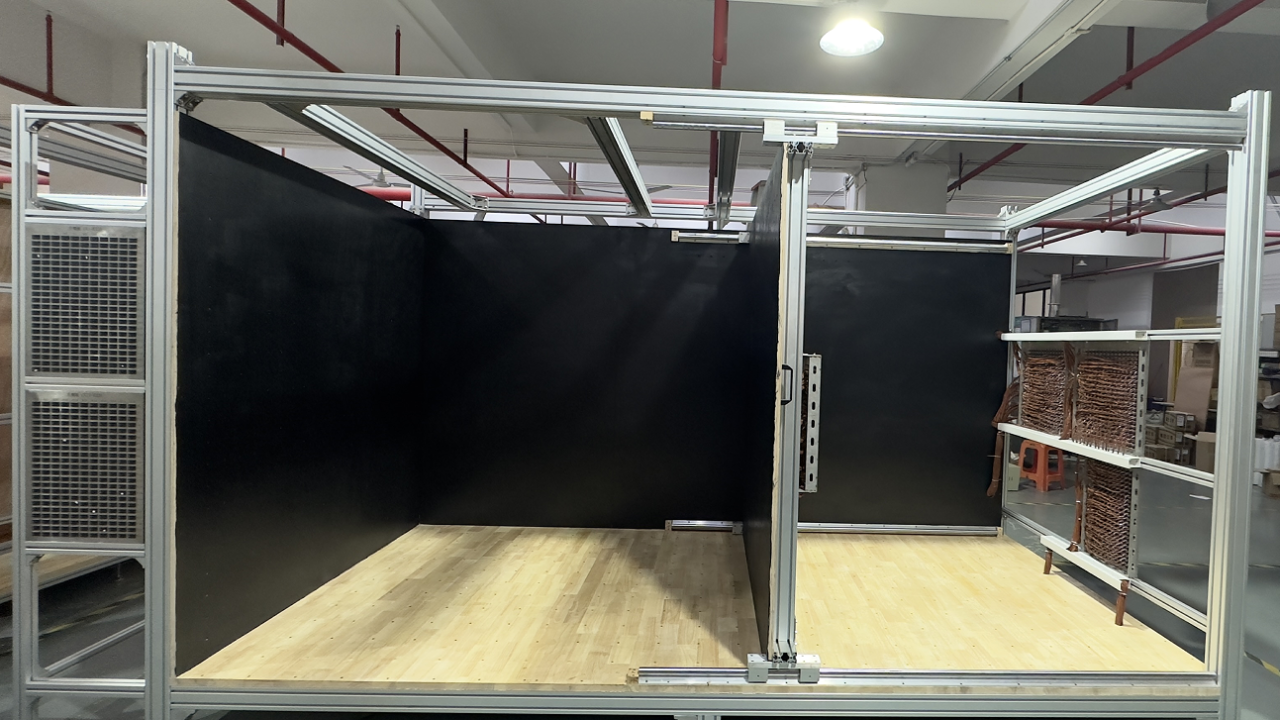
Beyond combustion benches, Wanhe supplied the environmental and mechanical-reliability side of appliance testing to brands including Vanward and Inse: rain and wind rigs, a needle-flame tester, carton compression, drop, vibration, abrasion, and outdoor-grill temperature-rise corners.
Appliance certification is not only about combustion – it also asks whether the product survives water ingress, fire enclosure, transport and outdoor heat. This case lists the real environmental and mechanical rigs delivered alongside our combustion benches, complementing the environmental test chamber and custom / walk-in chamber range.
In this case study:
- Ingress and wind
- Flame and mechanical safety
- Transport and handling
- Vanward outdoor-grill corners
1. Ingress and wind exposure
Delivered environmental stations include rain test rigs (Xiangji, Langli), back-flow / downdraft wind rigs (Xiangji) and cross-blow wind rigs (Xiangji, 2026) – used to check enclosure protection and flue behaviour under wind. A computerised air-constant-temperature control system (WH-HW03-103) went to Yu’an for controlled environmental conditions.
2. Flame and mechanical safety
The suite includes a needle-flame tester (WH-HJ23-ZY100) and a carton compression tester (WH-HJ23-YL200, 1-station), both supplied to Inse (Cherry), a digital oxygen-index meter, and a glass-impact test bench (WH-ZJ012026011216) at Shandong Yimu. The needle-flame rig validates flame enclosure of plastic parts, a mandatory safety check for mains-connected appliances.
3. Transport and handling
Mechanical reliability rigs delivered include a drop tester (Zhimeini, 2026), a simulated-transport vibration table (WH202502A, Zhimeini), an abrasion/rub tester (WH202502B, Zhimeini), a clamping/compression test stand (WH-HJ23-JB150, supplied to both Inse and Zhime) and a stacking/compression test machine (Shengbang). A running-horse auto-mould test bench (WH-HJ23-PM09) went to Inse as purchased equipment.
4. Vanward outdoor-grill temperature-rise corners
For outdoor cooking products, Vanward took two North American outdoor-grill temperature-rise test corners: WH-KL02-1605 with J-type thermocouple probes and WH-KL02-1605B without, plus a heater temperature-rise corner (WH-QL02-1712). These corners provide the controlled heat source and thermocouple layout used for outdoor-grill and heater safety assessment, and tie into the outdoor grill test bench range.
Frequently Asked Questions
Do you supply environmental rigs beyond climate chambers?
Yes – rain, downdraft/cross-blow wind, needle-flame, carton compression, drop, vibration, abrasion, oxygen-index and glass-impact stations have all been delivered.
Is outdoor-grill temperature-rise testing supported?
Vanward took WH-KL02-1605/1605B outdoor-grill temperature-rise corners (with and without J-type probes) plus a WH-QL02-1712 heater corner for safety assessment.
Which named customers use these rigs?
Inse took the needle-flame tester, carton compression and clamping rig; Vanward took the outdoor-grill and heater temperature-rise corners; Zhimeini took drop, vibration and abrasion rigs.
Are these rigs suitable for packaged-goods testing?
Yes – drop, vibration, abrasion, clamping/compression and stacking stations cover transport and handling reliability.
Engineering and site integration
Environmental rigs sit alongside combustion benches in a reliability lab, and each has its own service requirements: rain rigs need a water supply and drain, needle-flame and temperature-rise corners need gas and exhaust, drop and vibration tables need a flat isolated floor. We deliver each as a self-contained unit on its own frame, with the control panel, safety guards and emergency stop integrated. The Vanward outdoor-grill corners are built to a defined wall-and-hearth geometry so thermocouples are placed at repeatable positions, and they burn at controlled gas supply. On site we connect services, run a short dry cycle, verify the safety interlocks, and hand over manuals and thermocouple position diagrams. Where the lab also needs controlled gas mixtures – for combustion-air ratio or special-atmosphere tests – we supply the matching two- and three-component automatic gas-blending systems (WH-ZD09 series), which proportion reference gases ahead of the bench. This complements the climatic test chamber range for combined reliability programmes.
How a custom bench is specified
When a customer comes to us for a bench like the ones in this case study, the first working exchange is a short questionnaire rather than an instant price: we ask for the product drawings and range of models, the test clauses or standards the bench must satisfy, the required production beat or throughput, the local gas type and pressure, and the on-site utilities (compressed air, water supply and drain, power, exhaust). From that we issue a block diagram, a floor-layout sketch, a station list and a proposed acceptance checklist, then refine the fixture design together before fabrication begins. Every machine goes through a factory acceptance run with a sample part before shipment, and on-site commissioning is carried out with the customer’s engineers present. This front-loaded specification step is why retrofits – such as the Ferroli valve-circuit upgrade and the Geyou single/dual conversions – can reuse existing frames without surprises.
Looking for a similar configuration for your own product range? Wanhe Testing designs and builds custom gas-appliance test benches in Zhongshan, China, and has supported manufacturers, component suppliers and third-party test houses since 2011. Request a quotation or review our other testing-equipment case studies.