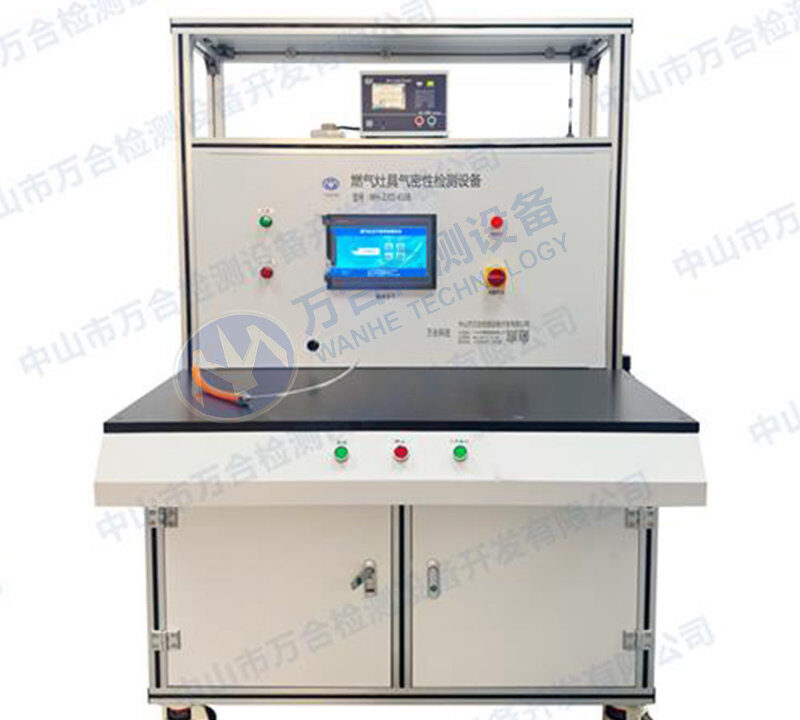
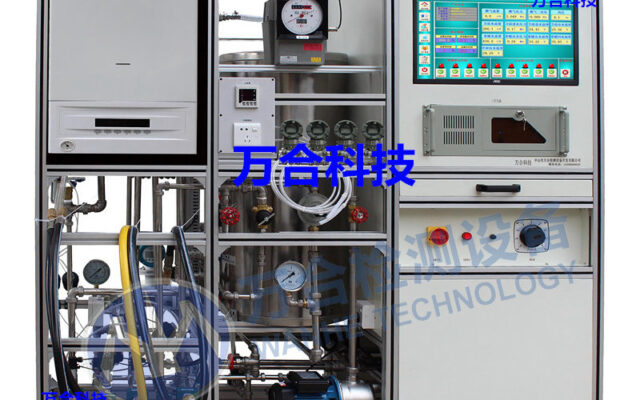
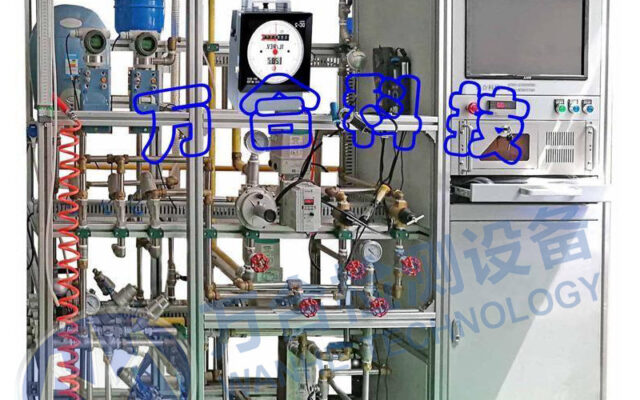
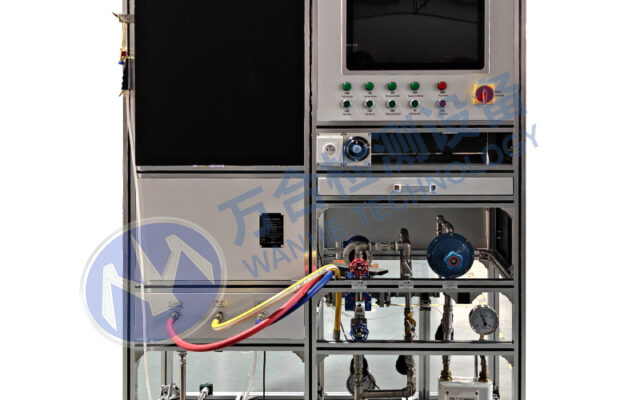
The Gas Stove Gas Tightness Test Bench (Model WH-MJ06-601A) is a dedicated leak-detection station for gas stove manifolds, gas pipelines and safety valves. Using high-sensitivity pressure-decay measurement with automated pass/fail judgment, it identifies unsafe gas escapes before a stove reaches packing — the single most important safety check on a gas cooker line. Because a leaky appliance can cause fire or carbon-monoxide incidents, manufacturers use the WH-MJ06 to verify 100% of units rather than relying on spot checks.
The bench is a focused, high-sensitivity machine: when a plant also needs combustion, efficiency and flame-failure tests, the gas stove test bench or the gas appliance test bench combine these on one platform. The method and standards are explained in our gas tightness testing machine guide.
What the Bench Tests
- Manifold gas tightness — pressure-decay leak testing of the stove’s internal gas manifold.
- Pipeline & joint leaks — connections, fittings and gas tubing under test pressure.
- Safety valve sealing — leak-tight behaviour of shut-off and regulating valves.
- Automated judgment — measured pressure loss compared with the standard’s limit.
Standards & Compliance
Gas-tightness requirements for cookers are set out in EN 30-1-1 and China’s GB 16410; the general requirements are aligned with IEC 60335-2-102. Our technical article on gas tightness and flame failure testing summarizes the pressure, duration and pass criteria and the equipment used. The bench records the pressure trace so the result is auditable.
How the Test Works
- The manifold is sealed and pressurized to the test pressure defined for the appliance.
- After a short stabilization period, the system records pressure decay over the hold time.
- The measured drop is compared with the standard’s allowable limit.
- A pass/fail verdict and the pressure trace are stored against the unit’s serial number.
Key Features
- High-sensitivity pressure-decay detection for production-line leak testing.
- Automated pass/fail judgment removes operator interpretation.
- Multi-station configuration for parallel testing.
- Traceable pressure data and report export.
- Customizable fixtures for different stove and manifold designs.
Manual vs. Automatic Leak Testing
| Parameter | Specification |
|---|
| Test Object | Gas stove manifold, gas pipeline, safety valve |
| Leak Detection | High-sensitivity pressure decay & leak rate measurement |
| Test Pressure | Adjustable per standard & product |
| Judgment | Automatic pass/fail with tolerance settings |
| Stations | Independent stations, expandable |
| Data | Traceability and report export |
| Control | Touch screen + PLC, automatic recording |
| Standards | IEC / EN / GB compliant |
| After-sales | 1-year warranty & remote support |
Applications
- Gas stove manufacturers — production-line gas tightness verification before packing.
- Gas valve & manifold plants — incoming and outgoing leak testing of components.
- Certification laboratories — standard-compliant leak measurement with traceable data.
For combined combustion and efficiency testing, see the gas stove test bench; for valve components, see solenoid valve test equipment.
Why Manufacturers Choose Wanhe
Wanhe Testing (Zhongshan, Guangdong) has designed and built gas-appliance test benches for appliance makers and certification laboratories for more than 15 years. Each bench is manufactured and calibrated in-house, ships with a 1-year warranty plus lifetime technical support, and can be OEM/ODM customised for your gas type, station count and data format. You can review our compliance credentials on the certifications & compliance page, compare the factory-direct model on Factory Direct, and read a buyer-focused checklist in how to choose a test-equipment manufacturer.
- Direct manufacturer — factory pricing, no trading-company margin; see factory direct vs trading company.
- Traceable results — 0.5-class pressure and flow measurement with automatic pass/fail reporting.
- Custom engineering — LPG/NG/town-gas, 1–6 stations, PLC/MES connection and custom fixtures; see custom lead time.
- Export documentation — CE/ISO support and technical files for target-market certification.
Request a Configuration & Quotation
Send us your appliance models, target markets and the standards you must meet (EN, IEC, GB or ANSI). Wanhe engineers will propose a station layout, confirm the measurement ranges and provide a quotation with lead time and MOQ. Use the contact form, or review typical budget ranges in our gas test equipment price guide.
Frequently Asked Questions
Pressure decay or water-bath leak testing?
The WH-MJ06 uses pressure-decay measurement, which is clean, automatable and traceable for production lines; water-bath methods are slower and operator-dependent. The exact method is configured to your standard.
Can it test every stove on the line?
Yes. The bench is designed for 100% inspection with multi-station parallel testing and automatic judgment.
Does it test flame failure too?
It focuses on tightness; flame-failure timing is included on the gas stove test bench and described in the standards article.