
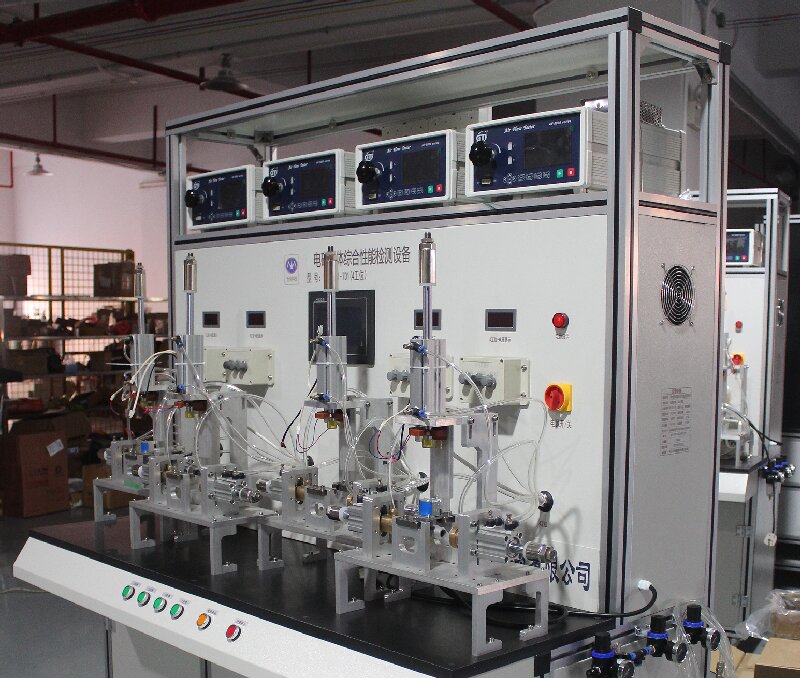
How a Vietnamese water heater plant multiplied endurance testing throughput sixfold with a production-integrated aging line — parallel cycling, per-station control and reliability data at volume.
Reliability testing has a volume problem: testing one or two water heaters in a lab tells you about those units, not about your production. A Vietnamese manufacturer needed endurance evidence at production scale — many units cycling simultaneously, with independent control and data per unit, integrated with the plant’s flow. This project overview describes how we designed and delivered a 6-station water heater aging line that turned reliability testing from a bottleneck into a production capability.
- The Reliability Testing Bottleneck
- The Requirement
- The Solution: A 6-Station Aging Line
- How the Line Works
- Instrumentation and Data
- Production Integration
- Results and Lessons
- Frequently Asked Questions
1. The Reliability Testing Bottleneck
Gas water heaters are endurance products: valves, gas circuits, ignition systems and safety functions must survive years of cycles. The standard approach — testing a few samples in a lab — gives design confidence, but it cannot answer the production question: is this batch as reliable as the last one?
The Vietnamese plant faced exactly this gap. They had:
- Lab-scale endurance testing for design validation — sound, but throughput limited to one or two units at a time.
- Production-volume needs — their customers increasingly asked for reliability evidence on supplied batches, and the plant wanted aging data as a standard QC output.
- Floor space pressure — the plant could not dedicate a large lab area to endurance testing.
The goal: endurance testing at production scale, on the same floor space as a lab bench, with data good enough for customer qualification.
2. The Requirement
The requirement, agreed in specification rounds:
- Six stations, parallel cycling. Six water heaters running endurance cycles simultaneously, each station independent — one unit’s failure or maintenance must not stop the other five.
- Per-station control and data. Each station with its own cycle programme, water supply and measurement, and its own data record.
- Production-friendly operation. Loading and unloading units quickly, standardised cycles, clear pass/fail output per station.
- Documented evidence. Reliability records per unit: cycles completed, measurements, any anomalies — the data package for customer qualification.
3. The Solution: A 6-Station Aging Line
We designed and built a 6-station water heater aging line with the following architecture:
- Six independent stations on a single frame, each with its own water supply, cycle controller and measurement channel.
- Per-station endurance cycles — each station runs its assigned cycle (on/off sequences, flow conditions, safety function checks per the programme), independent of the others.
- Centralised supervision — all six stations’ status and data visible on one screen, so the QC operator sees the whole line at a glance.
- Measurement per station — flow across the operating range, safety function verification, and cycle counting, drawing on the instrumentation principles of our WH-RS03-501A water heater test bench (0–30 L/min range, 0.5% F.S. instrumentation).
The line is sized and laid out for production operation: quick unit mounting, standardised connections, and a control interface designed for QC staff.
3.1 Safety and Reliability Features
A line that runs endurance cycles continuously must itself be reliable and safe — six gas-fired appliances cycling on one line means gas, water and electrical risk that the design has to manage:
- Per-station safety isolation. Gas and water supplies per station with isolation valves, so one station’s unit can be serviced or removed while the others run.
- Leakage and anomaly protection. The line is equipped to detect abnormal conditions per station — the same gas safety logic that our gas test benches apply to production testing.
- Alarm handling. Each station’s alarm is localised and identified on the central screen, so the operator knows exactly which unit and which condition — no hunting across six stations.
- Ventilation and drainage planning. The line’s installation requirements (ventilation for combustion, drainage for the water circuit) were specified with the plant’s conditions, so installation did not create new hazards.
Reliability testing equipment that is not itself reliable fails the department it serves. These features are why the line’s uptime — not just its capacity — is the real measure of its value to the plant.
4. How the Line Works
A typical day on the line:
- Load. Six production water heaters are connected to their stations — water, gas and measurement connections per station.
- Programme. The QC operator selects the endurance cycle for the batch (the cycle programme is defined per model family in the specification).
- Cycle. Each station runs its programme — ignition, operation, shutdown, safety function checks — repeating the cycle and counting cycles per unit.
- Monitor. The central screen shows all six stations: cycle count, current status, any alarm or anomaly per station.
- Record. On completion (or on failure), each unit has its own data record: cycles completed, measurements, anomalies — the reliability evidence per unit.
Because stations are independent, a unit that fails early does not hold the line: it is removed, its record is flagged, and the station is reloaded while the others continue.
4.1 Commissioning and Training
An aging line is a production tool, and like any production tool it earns its place when the team can run it as routine. The Vietnam project included the commissioning and training that made the line operational from week one:
- Video commissioning. Our engineers guided the plant’s team through installation, utility connections and verification step by step — the plant’s technicians did the physical work, with our engineers directing remotely and checking every step before the line started its first cycle.
- Operator training. The QC operators were trained on the full daily workflow: loading units, selecting programmes, monitoring the central screen, handling alarms, and extracting records. The goal was that the line runs without an engineer present — and it does.
- Programme configuration guidance. The plant’s quality team learned how cycle programmes are defined and adjusted, so new model families can be added with remote guidance rather than a service visit.
This is the delivery pattern for all our export projects: the equipment arrives with the knowledge to run it, and the support line stays open afterwards.
5. Instrumentation and Data
The line’s value is in its data. Per-station measurement covers:
- Water flow and conditions — within the operating range, so endurance conditions match real use.
- Safety function verification — flame failure and safety responses checked within the cycle where the programme requires.
- Cycle counting and timing — cycles completed, per-cycle timing, cumulative runtime.
- Anomaly capture — the record includes any deviation or alarm, so a unit’s reliability story is complete, not just its final pass/fail.
The data output per unit becomes the plant’s reliability record: a customer can see the unit’s cycles, conditions and checks. That is the difference between “we tested it” and “here is its testing history.”
6. Production Integration
An aging line earns its place only if it fits the production rhythm:
- Footprint. The 6-station line occupies the space of a lab bench arrangement — no large lab hall required.
- Utilities. Water supply, drainage, gas supply and power were specified in the quotation with the plant’s actual utility conditions, so installation was straightforward.
- Operator workflow. Loading, programme selection and result review are designed for QC staff; the training was delivered as part of commissioning.
- Throughput. Six units in parallel multiplied the plant’s endurance testing capacity on the same floor space — and the line runs continuously, so aging data is produced as a routine output, not as an occasional campaign.
7. Results and Lessons
What changed for the customer:
- Sixfold throughput. Endurance testing at production scale instead of single-unit lab samples.
- Statistically meaningful data. Reliability evidence across multiple units per batch, not one lucky (or unlucky) sample.
- Customer-qualification strength. Per-unit aging records became part of the plant’s quality package for its buyers.
Lessons for similar projects: independence of stations is the design feature that keeps a multi-station line productive; per-station data is what makes the line’s output credible; and production integration (utilities, workflow, training) determines whether the line runs daily or gathers dust. An aging line is a production tool — design it like one.
7.1 Expanding the Line Later
Reliability evidence rarely stays a one-line requirement — as the plant’s customer qualification demands grow, the line can grow with them:
- More stations. The line’s architecture supports expansion — additional stations can be added following the same design, so capacity grows with the plant’s throughput instead of forcing a replacement.
- More measurement depth. If customers later require additional measurements per unit (e.g. gas-side data, safety function timing records), the instrumentation can be extended on the existing stations where the specification left room.
- Integration with other equipment. The plant may later add environmental conditioning (temperature/humidity aging of components) or production-line test benches alongside the aging line — all built on the same data and documentation standards.
We designed the project so that the next investment builds on this one — the plant’s reliability capability grows incrementally, with each stage documented and supported the same way as the first.
8. Frequently Asked Questions
How many stations do I need?
Stations follow your throughput need: how many units per batch, how long per cycle, how much capacity your production requires. Six stations is a proven configuration; lines from 2 to 10+ stations are designed per requirement — and the sizing discussion is part of the specification round, before any commitment.
Can the line test different models?
Yes — cycle programmes are defined per model family, and stations can run different programmes at the same time if your production mixes models. The programme set is agreed in the specification, and new model families are added with remote guidance as your product range evolves.
What does the data record look like?
Each unit gets its own record: cycles completed, per-cycle timing, measurements, safety function checks and any anomalies — exportable for your quality system and customer qualification. The record is the reliability evidence your buyers can read, not just a pass/fail line on a screen.
Does the line need special utilities?
Water supply, drainage, gas supply and power per the specification — confirmed against your plant’s conditions before manufacturing so installation is straightforward. The specification states the utilities explicitly, and commissioning verifies them step by step.
What if one unit fails during cycling?
The station stops and flags the failure immediately; the other stations continue running. The failed unit’s record is complete — cycles, measurements and the anomaly — which is exactly the reliability information you need to decide whether it is a one-off or a production trend.
Can the line test electric water heaters as well?
The line is configured around the customer’s products — gas water heaters in the Vietnam project. Electric water heater endurance has different measurement requirements (electrical rather than gas-side), and a mixed or dedicated configuration can be designed from the same architecture. State your product mix in the requirement, and the specification round covers it.
How long does an aging line project take?
After the specification is agreed, the design phase runs about 7–15 days and manufacturing about 30–45 working days for a custom line, stated in the quotation. Commissioning follows shipment — by video with your team, or on-site for larger projects.
What is the minimum batch size that justifies an aging line?
An aging line pays for itself when you need reliability evidence across multiple units regularly — even 2–3 units per week across six stations makes the line a routine production tool rather than a lab campaign. If you only test occasionally, a single test bench with endurance capability may serve you better; we will advise honestly on which fits your situation.