
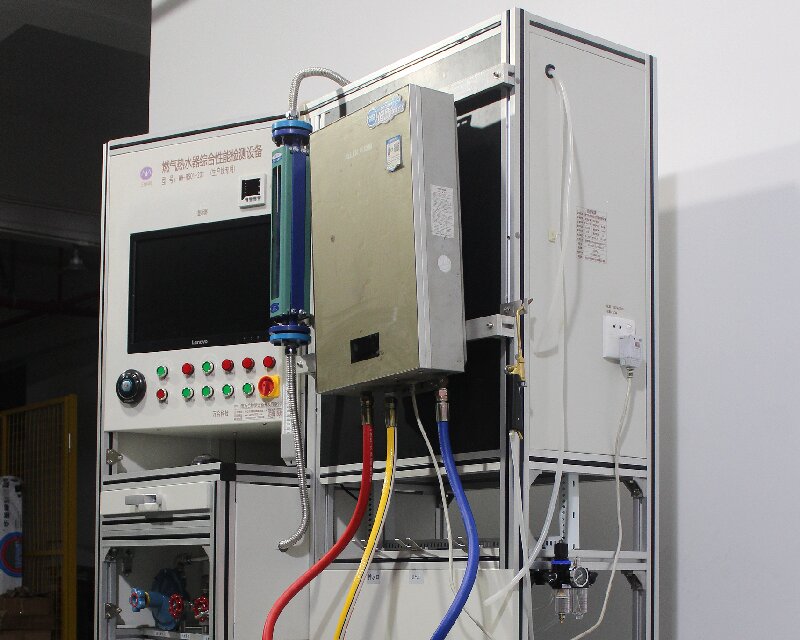
How a European testing laboratory acquired a certification-oriented wall-hung boiler test bench from China — the specification standard, the documentation trail, and the support relationship that made an intercontinental purchase work.
Buying test equipment across continents is a different decision from buying locally: the laboratory’s clients depend on the data, the certification bodies scrutinise the method, and the buyer cannot walk into the factory to check the machine. This case study documents how we supplied a wall-hung boiler test bench to an EU laboratory — what the laboratory required, how we met the standard, and what made the project succeed despite the distance.
- The Laboratory and the Challenge
- Why an EU Lab Would Buy from China
- The Requirement: Certification-Oriented Testing
- The Solution: A Wall-Hung Boiler Test Bench
- Documentation and Traceability
- Delivery, Commissioning and the Support Relationship
- Results and Lessons
- Frequently Asked Questions
1. The Laboratory and the Challenge
The customer is a European testing laboratory serving boiler manufacturers — testing wall-hung boilers for performance, efficiency and safety verification, with data that must withstand the scrutiny of the laboratories’ clients and their certification bodies.
The challenge was not simply “buy a bench.” It was: acquire a testing station whose data is defensible, whose methods match the standards European boiler work demands, and whose documentation supports audit trails — from a supplier who would have to be trusted across half the world.
The laboratory’s decision process was accordingly rigorous: written specifications, technical clarifications, documentation review, and verification of the supplier’s engineering depth — the same process any serious lab applies, made harder by distance.
2. Why an EU Lab Would Buy from China
A European laboratory can buy locally, so why consider a Chinese manufacturer? The answer is the same reason many European factories and labs now source test equipment from China:
- Engineering customisation. A bench built around the laboratory’s specific test scope, not a fixed catalogue product — modification without drama, at design level.
- Value for the specification. The same instrumentation classes and documentation depth at a cost that changes the lab’s investment case.
- Delivery integration. A manufacturer that handles export properly — documentation, shipping, commissioning support — reduces the risk of the distance.
The precondition is trust: the supplier must demonstrate the engineering depth and the documentation discipline a laboratory’s work requires. That is the bar this project had to meet.
3. The Requirement: Certification-Oriented Testing
The requirement was defined through written specification rounds. The key elements:
- Test parameters that matter in boiler certification: gas supply and combustion measurement, water-side flow and temperature control, thermal efficiency, and safety function verification.
- Test methods mapped to the applicable standards — the bench must support the test methods European boiler work references, with instrumentation class per measurement point.
- Data recording with traceability — values, conditions and timestamps that a certification body can follow.
- Documentation set — technical specification, acceptance test report, calibration records, operation documentation: the paper trail a laboratory needs.
Every item in the requirement traces to one principle: the data must be defensible. The bench is a measurement instrument inside the laboratory’s quality system, and the specification was written accordingly.
4. The Solution: A Wall-Hung Boiler Test Bench
We supplied a wall-hung boiler test bench from our WH-BG02-815A series, configured for the laboratory’s specific scope:
- Gas side. Gas supply with the required pressure regulation and measurement; provisions for the gas families the laboratory tests; combustion measurement capability per the test methods.
- Water side. Flow control and measurement across the boiler’s operating range, temperature control for the test conditions, and the hydraulic connections for the boiler’s water circuit.
- Performance and safety. Thermal efficiency measurement, safety function verification and the data recording the specification required.
- Instrumentation. Instrumentation classes per measurement point as specified — the classes that make the data acceptable to the laboratory’s clients.
The bench was built to the agreed specification, not a generic catalogue configuration — and the specification itself documented the standards mapping the laboratory required.
4.1 Bench Layout and Workmanship
A laboratory bench lives in a different world than a production bench — it must fit the laboratory’s room, its utility connections and its workflow, and it must present as the professional instrument its data claims to be:
- Compact, serviceable layout. The WH-BG02-815A series is designed for laboratory footprints — the bench’s connections, instruments and access points are arranged so the laboratory’s engineers can operate, maintain and extend it without special access.
- Instrumentation integrity. Measurement channels are positioned and protected so the laboratory’s own verification work can confirm calibration — the bench is built to be checked, which is the only way a laboratory trusts any instrument.
- Documentation-driven construction. Every subsystem in the specification (gas, water, measurement, control) is built to the documented configuration — so the delivered bench matches the specification the laboratory approved, item by item.
For a laboratory, the bench’s workmanship is part of its credibility: the instrument looks and behaves like the professional tool the data claims to come from. That is not cosmetics — it is the physical expression of the specification discipline the laboratory’s work depends on.
5. Documentation and Traceability
For a laboratory, the documentation is part of the equipment. The delivery included:
- Technical specification — the agreed specification, the delivered configuration, and the standards/test method mapping.
- Acceptance test report — the bench’s performance verified at our factory against the specification before shipment.
- Calibration records — calibration certificates for the measurement channels, with traceability the laboratory could file with its quality system.
- Operation and maintenance documentation — procedures, maintenance guidance and the after-sales process in writing.
This documentation set is what turns a machine into a testing capability: it is the evidence the laboratory’s own audits and its clients’ expectations require.
5.1 Standards Mapping in Practice
“Built to the standard” is a phrase that only means something when you can trace it. In this project, the standards mapping worked like this:
- The requirement document listed the test methods the laboratory’s work references — the performance, efficiency and safety verifications their boiler clients require.
- Our specification mapped each test item to the method — the measurement point, the instrumentation class, the test condition — so the laboratory could review, clause by clause, whether the bench would produce the data its clients need.
- The acceptance test verified the mapping — the bench was tested at our factory against the specification’s items, and the acceptance report documented the results the laboratory would rely on.
- The delivered documentation closed the loop — the laboratory received the mapping as part of the documentation set, so its own quality system could file the evidence with the bench.
This is the difference between “our bench is used for boiler testing” and “our bench produces data for your specific test methods, mapped item by item.” The latter is what a laboratory can build its service offering on.
6. Delivery, Commissioning and the Support Relationship
An intercontinental delivery succeeds on planning and communication:
- Shipping and documentation. Export packing, shipping documentation and customs paperwork handled by our export team — the machine arrives in the condition it left, with the paperwork that lets it clear smoothly.
- Commissioning by video. Our engineers guided the laboratory’s team through installation and commissioning remotely — step by step, with the laboratory’s engineers doing the physical work under our direction. The bench was operational and producing verification data within the commissioning plan.
- The continuing relationship. After commissioning: remote diagnosis, spare parts arrangements, and support for modifications as the laboratory’s test scope evolves. The relationship continues because the laboratory’s work continues — new test scopes, new questions, same support line.
For the laboratory, the decision to buy from China was a decision about whether a supplier could deliver engineering depth and support across distance. The proof was in the commissioning and the months that followed.
7. Results and Lessons
What changed for the laboratory:
- Certification-oriented capability. A wall-hung boiler testing station whose data withstands scrutiny — the bench is part of the laboratory’s service offering.
- A documented system. The full documentation set integrates into the laboratory’s quality system and audit trail.
- A long-distance supplier that works. Video commissioning, remote support and spare parts logistics demonstrated that intercontinental supply can be reliable when the process is engineered.
Lessons for similar projects: a laboratory’s purchase is won on specification depth and documentation, not price — and a manufacturer that treats both as core work can serve European laboratories from China. The three keys: agree the standards mapping in writing, deliver the full documentation set, and engineer commissioning support as part of the product.
7.1 The Commercial Case in Retrospect
Looking back, why did the laboratory’s decision work? Three factors that any European buyer considering Chinese equipment should weigh:
- The specification was the contract. Every item — test scope, instrumentation class, documentation, delivery and support — was written and agreed before manufacturing. The laboratory bought exactly what it approved, and the acceptance test proved it.
- The support was engineered, not promised. Video commissioning with defined steps, remote diagnosis with defined response, spare parts with defined arrangements — the support process was part of the specification, so it could be evaluated and delivered.
- The cost case was real. The laboratory gained certification-oriented capability at a cost that changed its investment decision — not because quality was compromised, but because the engineering was efficient and the process disciplined.
For buyers weighing a similar decision, the lesson is that distance is manageable when the process is engineered: written specification, documented delivery, video commissioning, continuing support. Those four elements are what made a Chinese-built bench credible in a European laboratory — and they are available to any buyer who asks for them, on any continent.
8. Frequently Asked Questions
Can your bench meet European test requirements?
Yes — the bench is configured around the test methods your work references, with the instrumentation classes and documentation the laboratory requires. The standards mapping is agreed in the written specification before manufacturing, item by item, so what the laboratory approves is exactly what it receives.
Do you support commissioning in Europe?
Yes — we deliver video-based commissioning with your engineers, step by step, and can arrange on-site support for larger projects. For the EU laboratory project, commissioning was completed remotely with the laboratory’s team — a process that is now standard for our European deliveries.
What about documentation for our quality system?
The delivery includes the technical specification, acceptance test report, calibration records and operation documentation — the paper trail your quality system and audits require.
How do you handle calibration traceability?
Measurement channels ship with calibration certificates traceable to reference standards, and the calibration records integrate with your laboratory’s quality system. Third-party calibration at your end is supported by the documentation.
What if we need modifications after delivery?
The support relationship continues: remote diagnosis, modification consultation and spare parts arrangements. New test scopes are handled by the same engineering team that built the bench.
Do you provide the bench in other configurations (e.g. condensing boiler testing)?
The WH-BG02-815A series covers the boiler testing scope it is configured for — including condensing boiler parameters where the specification requires them. Describe your exact product and test scope; the specification round establishes what the configuration covers.
How does payment and shipping work for EU buyers?
Payment terms, Incoterms and shipping arrangements are stated in the quotation and contract — including export packing and shipping documentation handled by our export team. EU buyers commonly order with the documentation and commissioning process described in this case study, and the schedule is part of the contract so delivery expectations are explicit from the start.