
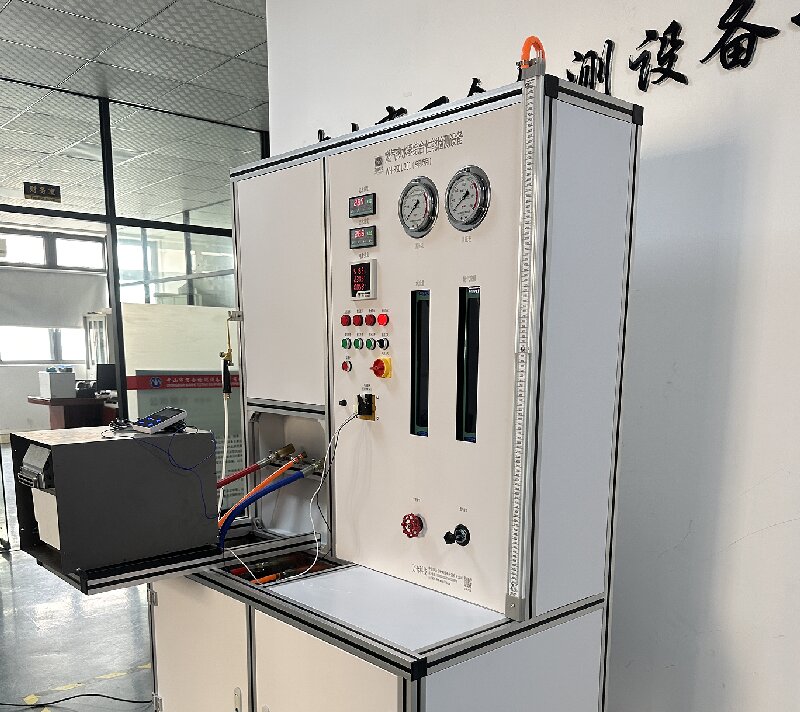
How a Thai gas cooker exporter moved from visual inspection to batch-level QC with a 12+ item export test bench — requirement, design, delivery and results.
Exporting gas cookers means selling trust in a product you will never see installed. For a Thai cooker exporter serving multiple regional markets, the turning point came when buyers began asking for per-batch test records instead of verbal assurance. This case study documents how Zhongshan Wanhe delivered a gas stove export QC test bench that turned production checks into objective, exportable evidence.
- The Company and the Problem
- The Requirement
- The Solution: A 12+ Item Export QC Bench
- Test Items on the Bench
- LPG/NG Readiness and Gas Supply
- Delivery, Commissioning and Support
- Results and Lessons
- Frequently Asked Questions
1. The Company and the Problem
The customer is a gas cooker manufacturer and exporter in Thailand with production for multiple regional markets. Before the project, their quality control relied on visual inspection, manual ignition checks and occasional sample testing. That approach served local sales, but two forces changed the equation:
- Buyer expectations. Regional importers increasingly requested test records per batch — evidence of gas tightness, ignition performance and thermal efficiency before containers shipped.
- Market competition. Exporters with documented QC won orders against those without, even at slightly higher prices, because the evidence reduced the buyer’s own risk.
The company decided to move from “we check carefully” to “here is the data” — and that decision required a test bench that could run standard checks repeatably on the production floor, operated by production staff, not by engineers.
2. The Requirement
The requirement was defined over several specification rounds. The key points:
- Core test items: gas tightness, ignition performance, flame characteristics, thermal efficiency and safety function checks on every tested cooker.
- Dual gas readiness: LPG and NG, because export markets used different gas families — the bench had to test with the right gas per model.
- Production-floor usability: a simple operator interface with standard test sequences and pass/fail records, so QC staff could run it without engineering training.
- Instrumentation credibility: 0.5-class instruments for flow, pressure and temperature — data that would survive scrutiny by buyers and, later, certification bodies.
- Compact footprint: fit into the QC area beside the production line without a rebuild.
3. The Solution: A 12+ Item Export QC Bench
We designed and built a gas stove export QC test bench around the GB/T 16411 gas appliance general test method family, configured for the customer’s models and gas supply. The bench integrates 12+ test items into a single work position, so an operator can run the full standard sequence on one cooker and record results without moving the unit between stations.
Design decisions worth noting:
- Operator-centric layout. Controls, gas connections and the cooker position were arranged for the production operator’s workflow — the bench tests the cooker the way the operator actually handles it.
- Standard sequences. Pre-programmed test sequences per model mean the operator selects the model and the bench runs the correct order and tolerances — reducing operator judgment to a minimum.
- Data recording. Each test run produces a record: values per test item, pass/fail result, date and operator. That record is the export evidence.
4. Test Items on the Bench
The bench covers the core gas cooker verification items:
| Test group | Typical items | Purpose |
|---|---|---|
| Tightness and supply | Gas tightness of the appliance and connections; supply pressure verification | Safety: no leakage, correct supply conditions |
| Ignition | Ignition time, ignition success rate, spark reliability | Reliability: lights every time |
| Flame | Flame characteristics, flame stability, burner performance | Combustion quality and stability |
| Thermal efficiency | Thermal efficiency measurement per the test method | Energy performance the market measures |
| Safety functions | Flame failure response, thermocouple/safety valve function where fitted | Safety function verification per model |
The exact item list per model is defined in the technical specification — this table shows the standard scope, and the bench is configured to the models the customer actually exports.
5. LPG/NG Readiness and Gas Supply
Gas family is a fundamental design input for a gas stove bench. The customer’s export models ran on both LPG and NG, so the bench included:
- Gas supply provisions for both families, with the correct supply pressure per gas type for the test conditions.
- Quick changeover between gas supplies so production can switch models without reconfiguring the bench.
- Gas mixing option where the customer’s future markets may need other gas compositions — the specification includes the upgrade path to a gas mixing system.
Getting the gas supply right at design time matters because the test data is only valid for the gas actually used — a bench set up for the wrong gas family produces numbers that look right and mean nothing. The specification, agreed in writing before manufacturing, removed that risk.
5.1 Bench Construction and Workmanship
A QC bench on a production floor takes a different kind of abuse than a lab bench: heat from nearby operations, dust, operator handling, and long continuous shifts. The Thailand bench was built with that reality in mind:
- Robust frame and surfaces — a welded frame and work surfaces that tolerate production-floor use, with the cooker position arranged for easy loading and connection.
- Protected instrumentation — flow, pressure and temperature instruments positioned and guarded so production handling does not compromise calibration.
- Clear connections — gas, power and measurement connections labelled and arranged so operators connect the cooker correctly every time, and mistakes are visible at a glance.
- Serviceable design — consumables (seals, fittings, sensors) accessible for routine maintenance, with the spare parts arrangement agreed at order.
Workmanship is the part of the specification that never appears in the quotation but shows up in the machine’s fifth year of service. For a production QC bench, it is not a cosmetic matter — it is the difference between a machine that still holds its accuracy and one that has drifted into meaninglessness.
6. Delivery, Commissioning and Support
The bench was manufactured, acceptance-tested at our factory in Zhongshan, and shipped to Thailand. Commissioning support was delivered by video, with our engineers guiding the customer’s QC team through installation, gas connections, calibration verification and operator training — the production operators were running the standard sequences within days.
The support relationship continued after commissioning: remote diagnosis for any question, documentation for their QC system, and spare parts arrangements for consumables. For an international buyer, the delivery process matters as much as the machine — the project was planned so the customer always knew what happened next.
6.1 Training and Documentation
Equipment only produces value when the people using it understand it. The Thailand project included the two pieces that make a bench operational rather than installed:
- Operator training. The QC team was trained on the standard sequences: selecting the model, running the test, reading the result, handling a failure, and recording the output. The goal was simple — every operator on every shift runs the same test the same way — because that consistency is what makes batch-to-batch records comparable.
- Documentation set. The bench shipped with the technical specification, the acceptance test report and the operation and maintenance documentation. For the customer’s quality system, the documentation is what makes the bench’s data defensible; for the maintenance staff, it is what makes the bench serviceable without depending on the supplier for every question.
This is the part of an export project that is easy to undervalue and expensive to skip. The machine is the same either way; the capability is not.
7. Results and Lessons
What changed for the customer:
- Batch-level evidence. Every tested cooker produced a record; every shipment could show buyer-facing data per batch.
- Standardised QC gate. A clear pass/fail process replaced inconsistent manual checks — the QC decision no longer depended on which operator was on shift.
- Stronger export positioning. The company could answer buyer questions with data instead of assurances — a commercial advantage in negotiations.
Lessons for similar projects: define the evidence your buyers demand before specifying equipment; agree the test item list and gas supply in writing; and plan commissioning support as part of the project, not as an afterthought. These three lessons apply to any export QC investment, not just this one.
7.1 Scaling to More Models and Markets
The bench was delivered for the customer’s current export models, but the design anticipated growth. Three scaling paths were built into the project’s architecture:
- New models. Adding a new cooker model means adding its test sequence and tolerances to the programme set — a configuration task, not a rebuild. The bench’s programme structure was designed so the QC team can be guided through additions remotely.
- New gas compositions. If the customer’s future markets require gas compositions beyond their current LPG/NG supplies, the specification includes the upgrade path to a gas mixing system — the bench’s gas architecture is ready for it.
- Additional test depth. As buyers’ requirements deepen (CO measurement, more detailed thermal analysis), the bench can be extended with the corresponding instrumentation — the data system and bench layout were designed with spare measurement channels in mind.
Export markets evolve, and a QC investment that cannot evolve with them becomes a constraint. Designing the upgrade path at the start — even if the upgrades happen years later — is the difference between a bench that serves the business and a bench that limits it.
8. Frequently Asked Questions
What does a gas stove export QC bench cost?
Cost depends on the test item scope, instrumentation class, gas supply configuration and customisation. We provide a written specification and quotation after understanding your models and test requirements — the range is wide, and the specification decides the price. The quotation includes the test item list, delivery terms and the documentation set, so the comparison is apples to apples.
Can the bench test my specific cooker models?
Yes — the bench is configured around your models: burner arrangement, gas type, test sequences and tolerances. The design cycle for a custom bench is typically 7–15 days, and the specification is agreed in writing before manufacturing begins.
Do I need engineers to operate the bench?
No — the bench is designed for production QC staff: select the model, run the standard sequence, read the pass/fail result. Operator training is part of commissioning, and the goal is that every operator on every shift runs the same test the same way — that consistency is what makes batch records comparable.
What about spare parts and support after delivery?
Our export support includes 24-hour response, remote diagnosis, spare parts shipment and documentation. For the Thailand project, commissioning was delivered by video with the customer’s team, and support continues today — the relationship, like the bench itself, was built to last for the equipment’s full service life.
Can the bench be upgraded later (e.g. add a gas mixing system)?
Yes — the specification includes the upgrade path. Adding gas mixing, new test items or new model configurations is designed into the bench’s architecture from the start.
How long does the bench take to deliver?
Standard benches ship in about 15–25 working days; customised benches with this project’s configuration in about 30–45 working days, stated in the quotation. The production schedule is part of the contract, with progress updates along the way — so your planning never depends on guesswork.
Can we arrange third-party inspection before shipment?
Yes — we support third-party inspection at our factory before shipment, and the acceptance test report documents the verification per specification item. Buyers who want independent verification are welcome to arrange it; the process is standard for our export projects and gives the buyer the same confidence as a personal visit.