
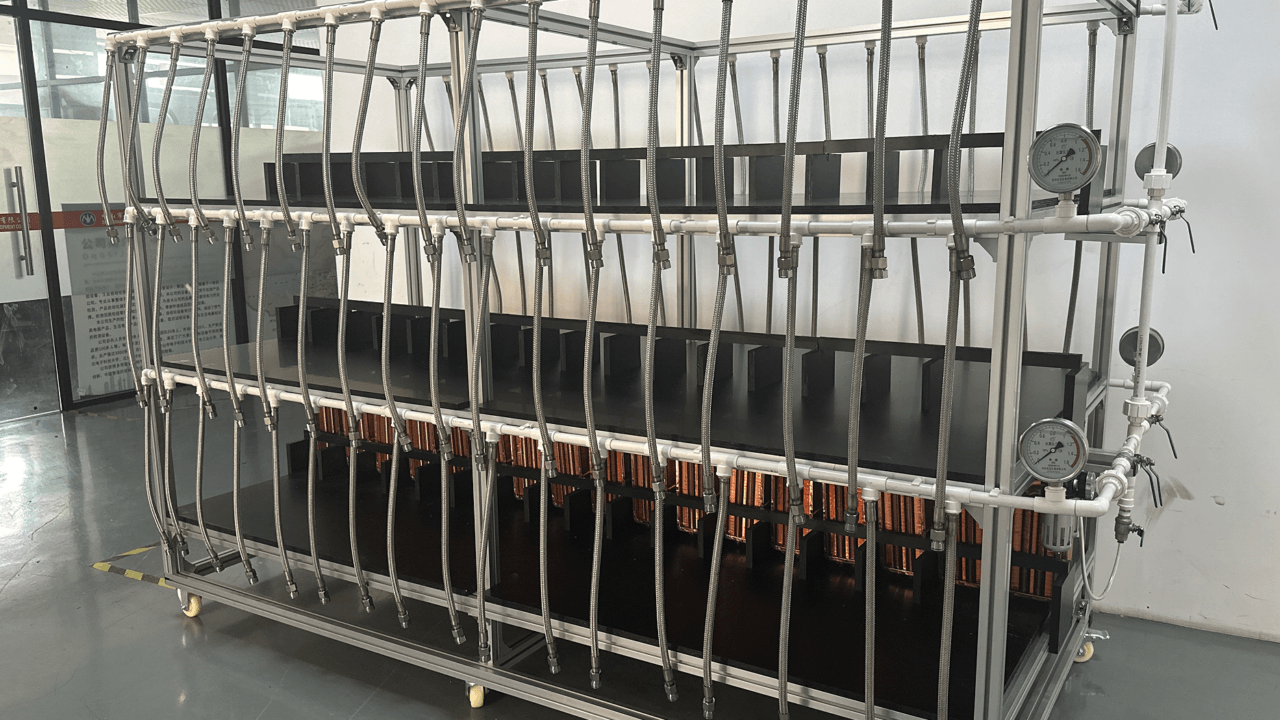
Wanhe has supplied gas tightness stations from 1, 2, 3 and 6 stations up to a 102-station water-tank line at Yu’an, all with automated differential-pressure pass/fail – configured to the part being sealed.
Gas leak tightness is the most common end-of-line check on any gas product. The challenge is matching station count and sensitivity to the part: a valve needs 2-3 stations, a heater body needs 6, and a large tank assembly needs a very high-channel line. Our gas stove gas tightness test benches show the approach; the delivered project list below spans the full range, ending at a 102-station line.
In this case study:
- Matching station count to the part
- The 102-station Yu’an line
- Equipment supplied
- Sensitivity and pass/fail
1. Matching station count to the part
- Small components (valves, distributors): 1-3 stations – e.g. valve-body and burner-head rigs at Shengbang and Hechuanda.
- Heater sub-assemblies: 6-station fixtures for water-body assemblies at Chaozhou Xindashun.
- Large tank bodies: a 102-station line at Yu’an for parallel leak checking.
2. The 102-station Yu’an water-tank line
Yu’an, a gas appliance components and OEM manufacturer in Shunde, took the largest single tightness installation: a 102-station water-tank body gas-tightness line (delivered October 2026). This runs a hundred-plus tank bodies in parallel with automated pressure-decide logic, the kind of throughput that only makes sense at high-volume tank production. Yu’an also took smaller tightness stations alongside its gas-distributor flow and nozzle test equipment.
3. Equipment supplied (real models)
| Model | Part under test | Stations / Customer |
|---|---|---|
| WH-ZJ01-416 / 416B | Cooktop valve body gas tightness | 2-3 stations / Hechuanda, Shengbang, Chenyuan |
| WH-ZJ01-419 | Cooktop burner-head tightness | 3 stations / Shengbang |
| WH-BG02-831 | Gas distributor tube tightness | Dual station / Yu’an |
| WH-QX02-1302 | Pump assembly tightness | 1 station / Heliang, Huixiang |
| WH-MQ02-1503 | Heater water-body assembly tightness | 6 stations / Chaozhou Xindashun |
| WH-ZJ01-429 | Whole cooktop tightness | End-of-line / Hemei Electric |
| WH-QM09-1026 | General gas tightness test unit | Chunmai Instrument |
| 102-station tank line | Water tank body tightness | 102 stations / Yu’an |
4. Sensitivity and pass/fail
Stations use automated pressure-decay / differential-pressure logic with a clear pass/fail output, so operators do not interpret readings on the line. Fixtures are matched to each part’s sealing interfaces. Pump-assembly units (WH-QX02-1302) were supplied both as bench units (Heliang) and as production-dedicated stations (Huixiang Tech).
Frequently Asked Questions
How many stations do I need?
It depends on the part and beat: valves and distributors are typically 1-3 stations, heater sub-assemblies 6, and high-volume tank bodies up to 102 stations in a line.
Is the result automatic?
Yes – each station runs automated pressure-decay pass/fail logic and outputs a clear accept/reject result, traceable to station number.
Do you build both component and whole-unit tightness stations?
Yes – from valve and distributor rigs up to whole-cooktop tightness (WH-ZJ01-429) and the 102-station water-tank line at Yu’an.
Which customer took the largest installation?
Yu’an took the 102-station water-tank gas-tightness line, alongside smaller distributor and nozzle flow equipment.
Engineering and site integration
Tightness stations are built on the differential-pressure principle: the part is pressurised, isolated from the reference, and the pressure decay over a set soak time is compared against a threshold set by the customer’s product spec. Small stations use manual loading, while the 102-station Yu’an tank line runs as an automated manifold with indexed fixtures, so a hundred-plus tanks are checked in one batch. Every station has its own pressure regulator, pneumatic valve and sensor, and a leak trips a visual reject light plus an interlock that isolates that circuit only. On site we connect compressed air, set soak times and thresholds on sample parts that are known-good and deliberately faulted, verify the interlocks, and hand over a record template per batch.
How a custom bench is specified
When a customer comes to us for a bench like the ones in this case study, the first working exchange is a short questionnaire rather than an instant price: we ask for the product drawings and range of models, the test clauses or standards the bench must satisfy, the required production beat or throughput, the local gas type and pressure, and the on-site utilities (compressed air, water supply and drain, power, exhaust). From that we issue a block diagram, a floor-layout sketch, a station list and a proposed acceptance checklist, then refine the fixture design together before fabrication begins. Every machine goes through a factory acceptance run with a sample part before shipment, and on-site commissioning is carried out with the customer’s engineers present. This front-loaded specification step is why retrofits – such as the Ferroli valve-circuit upgrade and the Geyou single/dual conversions – can reuse existing frames without surprises.
Looking for a similar configuration for your own product range? Wanhe Testing designs and builds custom gas-appliance test benches in Zhongshan, China, and has supported manufacturers, component suppliers and third-party test houses since 2011. Request a quotation or review our other testing-equipment case studies.