
Appliance durability is proven by cycling parts until they fail: Wanhe delivered a life-cycle lab for ZBOM kitchen appliances spanning drawer slides, push-rod motors, door locks, hinges, power boards and igniters, plus oven-door and packaging rigs for Zhimeini and whole-cooktop life rigs for Shengbang.
Endurance testing is where marketing claims meet physics: a hinge, a slide, a valve or an igniter must survive the cycles it will see in a customer’s home. Rather than one universal machine, each mechanism gets a purpose-built cycling rig. This case lists the real durability rig families delivered to a kitchen-appliance maker and its component partners.
In this case study:
- Why one rig per mechanism
- The ZBOM kitchen-appliance set
- Zhimeini oven and packaging rigs
- Gas valve and igniter endurance
1. Why one rig per mechanism
A drawer slide, a hinge and a push-rod motor move differently and wear differently, so each needs its own fixture, stroke and load. The delivered set reflects that: WH-JJ30 family for moving furniture parts, WH-ZJ01 family for gas-valve and ignition durability, and WH-KX02 family for oven hardware.
2. The ZBOM kitchen-appliance set
ZBOM (Zhibang Home Appliances), a major Chinese kitchen-cabinet and built-in appliance brand, took a six-rig life-cycle set: push-rod motor life test (WH-JJ30-1208), cabinet door & hinge durability (WH-JJ30-1212), drawer slide endurance (WH-JJ30-1207), door lock endurance (WH-JJ30-1209), power board aging (WH-JJ30-1205) and pulse igniter aging (WH-KX01-703). Together these cover the moving parts a built-in oven and hob go through in daily use.
3. Zhimeini oven and packaging rigs
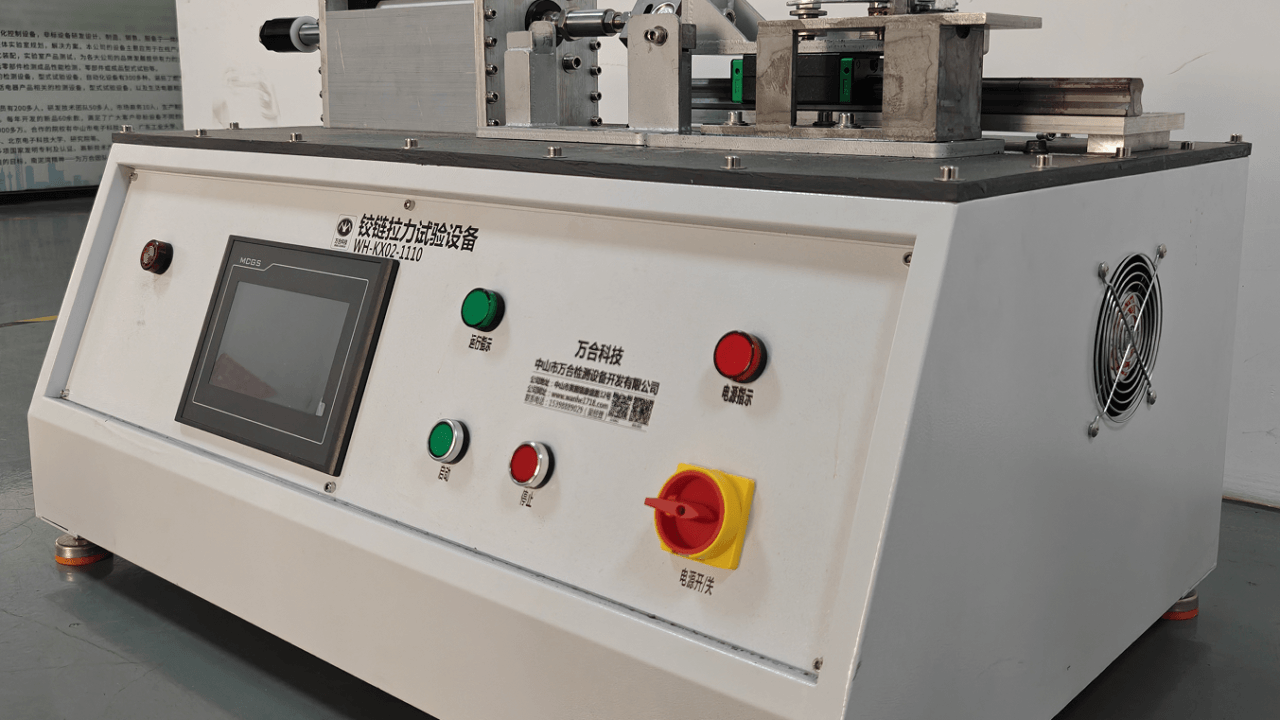
For oven manufacturer Zhimeini, Wanhe supplied gas oven door-frame life rigs (WH-KX02-1106), oven valve life rigs (WH-KX02-1109, two units), a hinge pull-force test device (WH-KX02-1110), a drop tester, a simulated-transport vibration table (WH202502A), an abrasion/rub tester (WH202502B) and a clamping/compression test stand (WH-HJ23-JB150). Shengbang added whole-cooktop life (WH-ZJ01-403, 2-station) and a stacking/compression test machine.
4. Gas valve and igniter endurance
Beyond furniture parts, the durability line includes whole-cooktop endurance (WH-ZJ01-402A at Beijing Chenyuan), valve-body aging (WH-ZJ01-403 at Jiexinlong), igniter durability (WH-ZJ01-405B), thermocouple durability (WH-ZJ01-415B), cock/stopcock valve endurance (WH-ZJ01-418), flame-failure protection endurance (WH-ZJ01-401B) and dry-boil protection endurance (WH-ZJ01-420). Production-line durability rigs are described in the production test bench range.
Frequently Asked Questions
Do you build one universal durability machine?
No – each mechanism gets a dedicated cycling rig with its own stroke, load and cycle counter, because slides, hinges and valves wear differently.
Which named customer took the kitchen-appliance set?
ZBOM (Zhibang) took six rigs covering push-rod motors, hinges, slides, door locks, power boards and igniters for built-in appliances.
Which gas parts are endurance-tested?
Delivered rigs cover gas valves, igniters, thermocouples, flame-failure protection and dry-boil protection, plus whole cooktops – much of it for the Beijing Chenyuan third-party lab.
Is packaging reliability tested too?
Yes – Zhimeini and Shengbang took drop, vibration, abrasion, clamping/compression and stacking stations for packaged goods.
Engineering and site integration
Durability rigs run for weeks or months, so mechanical and thermal reliability of the machine itself matters as much as the part under test. Slides, hinges and locks use motorised actuators with adjustable stroke, load and cycle count, and a counter that stops and logs on first failure. Gas-valve and igniter rigs cycle the parts through real gas and ignition so the wear profile matches field use. The ZBOM set, installed in a built-in-appliance R&D room, shares a common electrical cabinet architecture across the six rigs so operators learn one HMI. Safety interlocks cover over-torque, jammed actuators and gas-side flame failure, with guards around moving fixtures. Commissioning includes a short-cycle burn-in on each rig, stroke calibration, failure-log demonstration and on-site operator training.
How a custom bench is specified
When a customer comes to us for a bench like the ones in this case study, the first working exchange is a short questionnaire rather than an instant price: we ask for the product drawings and range of models, the test clauses or standards the bench must satisfy, the required production beat or throughput, the local gas type and pressure, and the on-site utilities (compressed air, water supply and drain, power, exhaust). From that we issue a block diagram, a floor-layout sketch, a station list and a proposed acceptance checklist, then refine the fixture design together before fabrication begins. Every machine goes through a factory acceptance run with a sample part before shipment, and on-site commissioning is carried out with the customer’s engineers present. This front-loaded specification step is why retrofits – such as the Ferroli valve-circuit upgrade and the Geyou single/dual conversions – can reuse existing frames without surprises.
Looking for a similar configuration for your own product range? Wanhe Testing designs and builds custom gas-appliance test benches in Zhongshan, China, and has supported manufacturers, component suppliers and third-party test houses since 2011. Request a quotation or review our other testing-equipment case studies.